As we approach Christmas 2018, and given the massive push to have cheap DNA tests given out as gifts this season, it seems natural to finally write a series on how to make genealogical use of a DNA test you, or your loved one, may have just taken.
We’re going to start with the very basics on how DNA testing works, and walk through both how to leverage AncestryDNA to track down ancestors as well as using GEDmatch and other advanced tools to go even deeper.
Assuming you have a few weeks before the test results are in, here are a couple of things to learn and prepare before you dive into the matches.
First, understand that while the commercials like to highlight the joys of learning your ethnicity, DNA testing raises serious issues that will likely come up as your journey progresses. You may uncover family relationships, both inside and outside of your family, that could have serious negative impacts on people. We’ve uncovered children born outside of marriages that were never known to the family, and we know of adopted children who were outed by tests where their parents had never told them. We wrote about an example of this last year (Dangers of DNA Testing).
Second, they key to effectively making matches will be a good, solid family tree through the test subject’s 4x Great Grandparents. Most of your matches made will be through 3x or 4x GGP, and in a perfect world the match will also have a good tree so the link will be obvious. We can’t over state this, or stress it enough: your success/failure of matching DNA tests from unknown relatives will rely on the quality and depth of your tree. We’ve walked through how to build a good “quick and dirty” Public tree on Ancestry (Building a good Public Ancestry.com tree – Part One: sources, citations, facts, and proof), and the process would be about the same on other sites, many of which are free.
It’s also important you have the tree available publicly…many of your interactions are going to be about exchanging trees to build a match. It’s ok if you have just a skeleton tree with basic information(names, date of birth/death, locations, children, etc.), but it will be key that you have something available publicly.
Finally, we covered some of the same advice we’re going to cover here previously, it’s not a bad idea to go through the highlights to get an idea of what to expect from your results. (What to expect from your genealogical DNA results).
Basics of DNA
The main new term/concept you’ll need for effective Genealogical DNA research is a measure of distance: centimorgan (cM). Now, it’s not technically distance…but for all intents and purposes, it’s used as a measure of distance.
What does cM measure?
Centimorgan measures length of DNA strands. More specifically, it will be used to measure the length of matching DNA segments between your test and a test that is a genetic match. For example, you have roughly 6800 cM if you take all 22 chromosomes and strung them out end-to-end, and your matches will have varying levels of matching DNA, measured by centimorgans.
How do we use centimorgans to identify matches?
Since you get about 50% of your DNA from each parent, your DNA tests will match a test from your parents with about 3400 cM. You will match a Grandparent with about 1700 cM (50% of your parent’s 50%). The more cM you match someone, the closer a relative they are, and the more likely that you will confirm a match with them.
We’ll use both charts from ISOSG (The Shared cM Project table) and an interactive version of that chart from the DNA Painter site (Shared cM Interactive Tool), which both break down the average cM to expect with various relatives, and helps us identify where to look to establish a match. For example, if a match is 311cM then we can guess they match the person with the DNA test at around a 1st or 2nd cousin…which means our common ancestor is likely a Grandparent or Great Grandparent, which narrows down our search!
What’s next?
So, there’s the first part of this DNA journey. There’s a little homework while you wait for the test results, a basic understanding about how we’ll actually leverage the DNA to make matches, and why your basicGenealogy and a solid family tree will be key to this process. Next week, we’ll go over what to do when you first get your DNA results!
Deed Books are a great tool to move forward some of your most stubborn research questions, and there is a great deal of data in them, but without a tool like DeedMapper you’re likely not going to get the full picture of what’s found in them!
On Michael’s paternal line, the Tradewell’s are one of the two brickwalls left on that side of the tree…which is all the more ironic because the matriarch of family history research on that line was Myra (Tradewell) Morse (1870-1962). In all of her genealogy notes, and DAR applications, and family history presentations she never recorded the name of her Great Grandfather…and thus we have a brick wall.
About a year and a half ago we wrote about discovering formal genealogical “Research Reports” (Elizabeth Shown Mills has just the right guidance at just the right time!) and started drafting them for our toughest cases. Of course, the Tradewell line was the first subject. We knew that James B Tradewell is our 4x GGF and that he arrived in Racine County, Wisconsin Territory ca. 1844, where he and his wife Catherine lived until their deaths. We also knew that there was an Ephraim Tradewell, and his wife Marina, also arrived in Racine County around 1844, and that both men listed New York as their birth location. A little research showed that there were a James B and Ephraim Tradewell in Schoharie County, New York for the 1820, 1830, and 1840 U.S. Census but each disappeared after that and no further records were found for them there.
We wrote an “Analysis and Research Plan” for them, and it laid out the following questions we’d hoped to answer:
Were the James B and Ephraim Tradewell in Wisconsin from after 1844 the same men as those listed in the 1820-1840 U.S. Census in Schoharie County, New York?
Were they related, and/or did they even know each other?
Who was each of their fathers, and was either of those persons the brickwall 5x GGF?
Reviewing the Schoharie County Deed Books for 1797-1850 gave us some of the answers, and DeedMapper filled in a major piece of the puzzle.
Were the Wisconsin Tradewells the same as the New York Tradewells?
The answer is now a proven yes! Deeds were usually recorded with the Husband as the only purchaser, but almost always the wife is listed when a property is sold. In fact, every Deed we reviewed where we know we had an ancestor selling property, the wife isn’t just listed, there’s a statement from the County Clerk that recorded the deed that the wife was taken aside out of the presence of her husband to confirm she was willingly agreeing to the transaction. Besides making us wonder if any wife EVER felt empowered enough to say “no”, several sales gave us the names of the New York Tradewell’s wives: James B Tradewell was married to Catherine (Edwards) Tradewell, and Ephraim was married to Marina Tradewell. A perfect match!
We also saw a clean break in New York, with the last Tradewell land transaction completed in the summer of 1842, and the first Wisconsin transaction being conducted in 1844.
Were James and Ephraim related, and/or did they even know each other?
We still do not know if they were related, but we know they were likely very close and in fact lived next to each other…and we never would have known that without DeedMaker. Just reviewing the Deed Books, we learned that they were involved in one land transaction that indicates they were likely in a close relationship. On 7 April 1838 James sold Lot #7 of “Tradewell’s Tavern Stand” in Gilboa, NY to Ephraim for $200. Two weeks later, on 21 April 1838 Ephraim sold the same property to Sidney Tuttle for $200. We’re not sure exactly what was going on there, but it’s very likely there was coordination between the men for this to occur.
But what really sold us on DeedMapper, was what happened when we mapped all the plots we discovered in the 1797-1845 Deed Books. The biggest breakthrough came when we first mapped two properties, with no common points in their Legal Description, and they clearly fit together. Without sharing Metes & Bounds points in the description (like a Willow Tree), there’s no easy way to determine how they relate, but when you map them visually you can see them like jigsaw puzzle pieces and get a great feeling of location for the land.
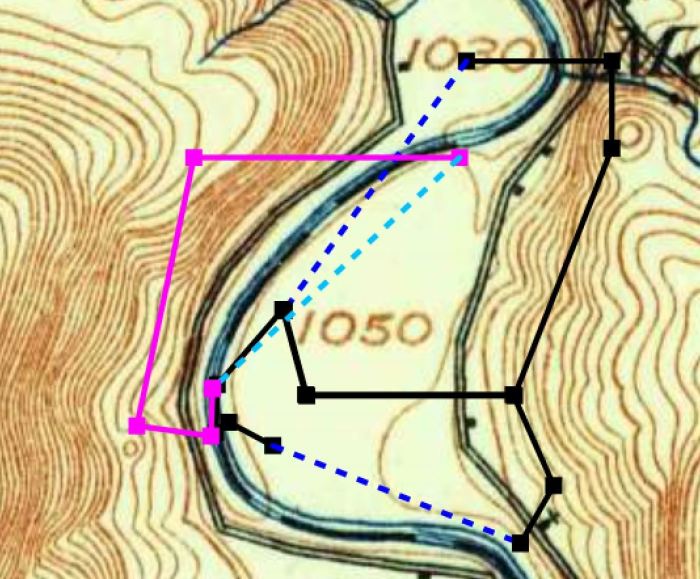
Once we had those two properties mapped (both were owned by James B Tradewell and recorded in 1806), we drew another plot owned by Ephraim (recorded 1834) and we immediately knew they lived together as neighbors with an adjoining property line.
Here is the first Legal Description for James’ largest plot:
Beginning at a Willow tree near the Schoharie Creek marked on the east side with the Letters C.E. and runs thence south 15 degrees east 10 chains and 60 links, thence East 25 chains, thence north 21 degrees 30 minutes east 32 Chains, thence north 10 chains 50 links, thence west 17 chains and 50 links to the Schoharie creek, thence along said creek to the place of beginning containing 117 acres of land be the same more or less.
And here is the Legal Description for Ephraim’s plot:
Beginning at a hemlock sapling on the East side of Schoharie Creek marked on 4 sides with 3 notches and a blaze on the North side B.H, on the South side I.D. and runs thence North 30 degrees East 8 chains, thence, North 24 degrees West 12 chains, thence, due West 25 chains, thence, North 15 West 10 chains 60 links, thence, South 41 degrees West 12 chains to the west side of said creek, thence, South 2 degrees West 5 chains 75 links, hence, North 52 degrees East 2 chains, thence South 62 degrees East 6 chains to the North East side of said creek, thence, up said creek to the place of beginning.
These two plots, recorded almost 30 years apart, and showing no common marker other than Schoharie Creek, when drawn, revealed just how closely these men lived:
The pink lines are the boundries of Ephraim Tradewell’s property, the black lines are James B Tradewell’s two plots. (Note: The maps don’t fit perfectly the boundary lines, because they specifically reference the edge of a creek that no longer exists and likely changed frequently after floods, etc.)
The beauty of DeedMapper is that this is first time we worked with Metes & Bounds land descriptions, the first time we’d recorded large amounts of deed information, and this was the 3rd time we’d ever entered information into the software. We literally knew almost nothing about what we were doing, and DeedMapper brought home how closely these men lived.
Now, it doesn’t prove James and Ephraim were related, and it’s likely only DNA will ever do that, but there is now no question these men had a close relationship. They weren’t distant cousins that lived miles apart in the same County, their families lived right next to each other.
Who was their father?
We still don’t know. This creek that’s referenced in so many of the deeds was dammed up in the 1920’s to provide drinking water to New York City, and all of this land is under a reservoir. However, that project caused the local Gilboa cemetery to be relocated, which gave us strong evidence that our 5x GGP were Reuben and Esther Tradewell, and if we can ever prove that James and Ephraim were brothers, we’ll then likely know Ephraim’s father too.
So, Deed Books are a great tool to move forward some of your most stubborn research questions, and there is a great deal of data in them, but without a tool like DeedMapper you’re likely not going to get the full picture of what’s found in them!
In recent weeks, many events came together that drove home something we’ve known for awhile: as genealogists we are not equipped to keep the family records we’ve collected safe enough, and we need to get them in the hands of those who can as quickly as possible. We can’t keep the treasures we’ve saved if we want to save them.
The thought first struck as Hurricane Florence slammed ashore a few weeks ago, and we wondered how many family history collections throughout North Carolina were about to be lost to history under feet of flood waters. And not just the collections like ours, but the little scraps of paper sitting in grandma’s drawers that would have given some future researchers a priceless insight into the lives of their ancestors. Probably 10’s of thousands of priceless documents (at least) were lost never to be documented, never to be appreciated or protected. Then Hurricane Michael hit and wiped out Mexico City, FL and laid a swath of destruction into Southern Alabama…and likely another round of loss of collections that would have added to the mosaic of our research.
Most of the plate glass negatives in the collection that we recently saved were eventually just thrown into a dumpster. We have about 25% of what was saved over the 48 years the studio was in business, but the other 75% was just thrown away.
But what finally brought it home to us, and stunned us so deeply that we had to take a few weeks off before writing this, was that most of the plate glass negatives in the collection that we recently saved (link) were eventually just thrown into a dumpster. We have about 25% of what was saved over the 48 years the studio was in business, but the other 75% was just thrown away. The person that we were able to buy these crates of slides from recounted that they had finished picking in the house that held the studio when they heard glass shattering from the cleaning crew throwing two crates into the dumpster. They realized the plates might be valuable, and asked if they could buy the remaining crates. The person in charge of the estate agreed, and our patron hauled 6 of the crates (at about 90 lbs. per 2’x2′ crate) before they realized they couldn’t carry more, or get them home, and so they left the rest there. The house was confirmed empty by the end of that day…nothing was left.
It didn’t have to be that way. The daughter of the studio owner the studio was approached by a local noted historian and collector over 20 years ago, after obtaining one of the crates and 1000’s of the studio images, and did everything he could to convince her to let him keep her collection safe. But, as someone who didn’t have the ability to let go of objects, she couldn’t part with them. Her house grew full of useless objects over the decades, and grew full of pets who made the house nearly unlivable, so that when she passed it was nearly impossible for the non-relative who inherited the property to sort through anything, even if they understood the historical value of what was in that basement. Instead of a carefully curated collection being kept safe and secure decades earlier, it was shattered in the bottom of a dumpster before it was dumped in a landfill.
Andrew and Anderson Thornton, twins, c. 1914.
From a 1910 dinner at the Taft White House
In some ways we are like that daughter of the studio owner. We have spent countless hours recovering and protecting some of the most amazing documents. We’ve found pictures of our African American great grandfather, and his twin brother, from a time and place where people of color wouldn’t normally have their photos taken, as well as another great grandfather’s White House place card from the Inaugural Ball of William Howard Taft. These are historic, priceless items that bring us great joy and pleasure. They remind us of the rush of the find, and the pride of the work we’ve done. But, as hard as it will be, we must get them out of our hands as quickly as possible and into those hands that can protect them forever. We’re only one bad storm, or one mislaid cigarette, away from losing them like so many others have been lost.
Early one Sunday morning in mid-August I woke up and checked my phone, and saw an eBay listing linked to a post on a Racine History Facebook group. The admin of the group was suggesting someone should buy these plates…and 39 minutes after he posted that plea, I checked the auction and it had ended. Someone had clicked the “Buy it Now” and the negatives were gone. It was the beginning of what’s going to be one of the biggest projects I’ve ever tackled.
This work totally diverges from our normal genealogy and family history research, and it’s a first for this blog to be writing about something outside of the journey of building out our son’s family tree…but something about doing this felt urgent. And luckily my wife indulges me when I tilt at windmills.
Tracking down the collection
After seeing the auction closed, I immediately emailed the seller with a polite request to confirm that the item had actually sold, and if there were any other cases that might be available. He replied back later that day that he had sold that case, but he was cleaning out a space for someone and there may be other cases. About a week later he reached out and said that he’d found 4 more cases, and agreed to sell them directly. We met him at a storage locker and I found he had 3 cases of 5″x7″ glass negatives and 1 case of 8″x10″ negatives. The larger plates were in very bad shape, but the 5×7’s were looked largely OK.
3 of the first 4 crates being picked up
The seller was a bit taken aback at the level of interest he’d received on the auction, and wondered why they were so popular. I explained that a collection of this size of these plate negatives was very rare, and that it likely captured an amazing slice of life in Racine…a slice that would be lost if the collection were broken up. We talked about my intention to get the collection together, make sure the plates were archived properly, scanned and shared publicly, and then donated to a museum that could protect them. The seller agreed to forward my contact information to the person who bought the case of slide we saw on eBay.
About two weeks later that original purchaser reached out to me and I learned he had actually purchased 2 cases, and that he’d sell those cases to me…at a small profit. A few days later we picked up those cases, and we found the scope of what we had: 5 cases of 5″x7″ dry plate negatives, most with two images per slide, for a total of about 2000 slides and 3000-3500 images, as well as 1 crate of 8″x10″ negatives, about 200 total images.
Where did these images come from?
These images were taken by Frank Stritesky who operated the Home Portrait Studio at 1022 High Street in Racine from 1916 through his death in 1964. Frank and his wife Anne were of Bohemian ancestry, and they lived in one of the largest Bohemian neighborhoods in the US, so this collection is likely a great snapshot of that population as well as hopefully showing how the neighborhood changed over the nearly 50 years the studio was in operation.
Frank was survived by two daughters, Betty and Dorothy. Betty never married, and lived with Anne until her death in 1973. Betty continued to live in the house on High Street until her death last year, and it looks like her friend that serves as the administrator of her estate is clearing out the house. The person that originally sold me the plates is a collector, and likely came across this collection as he helped clean out the home or through an Estate Sale. The negatives were probably stored in the basement of the studio, or the garage, which explains the condition issues.
As a side note, after a few posts that I made to the Racine History Facebook group another local historian reached out to me indicating that he had bought a case of plates from the family, before there were condition issues, as well as many prints made from these slides. He felt there could have been around 12,000 images total at the time of Frank’s death, which would mean our collection is only about 25% of what once was.
How are we archiving the negatives?
Our first worry is to get these dry plates stable, and protected, so they don’t continue to deteriorate. We have worked with large, important collections as a part of our family history research (Coming up with a plan to manage my new, huge family history collection) so we had a good idea of how to research the best way to archive these plates. We settled on Hollinger’s Four Flap Negative Enclosures (Four-Flap Document/Pamphlet Envelopes) placed in Dark Gray “Shoe Box” metal edge boxes (Short Lid Negative & Print Storage Boxes), surrounded inside with Ethafoam archival foam to cushion the slides (Artcare Archival Foam White Board). We can fit 70 slides in each box, and given how heavy they are, that works out to about 15 lbs. per box…which is manageable and easy to carry/store. Each box will be stored in a climate/humidity controlled room we have for our collections.
To clean or not to clean
Once I started unboxing the first crate of negatives, it became apparent just how affected by the environment these negatives were. The 5″x7″ were worse than I’d thought, and even the best of them shows a gradation in the photo emulsion that indicates likely water damage. Additionally most have a brown “dirt” on them that often caused the slides to stick together.
I have an extensive background in photography, having processed nearly 20,000 rolls over my lifetime. While my work is entirely on modern, plastic-based negatives, it still gave me confidence that I’d be able to master any needed cleaning techniques. My hope was that I could clean each plate, returning to as close as its original condition as possible. I was able to find an official Kodak publication that details the cleaning process for these exactly types of Kodak dry plate negatives, and it turns out I have most of the chemicals on hand since I still process my own B&W film from time-to-time.
I also reached out to several area museums and archivists in the area, and found white papers from archivists on how they had cleaned dry plate negatives like ours. The Kodak book was specific to removing what’s called “silvering” which is when the silver in the emulsion essentially tarnishes, which isn’t a huge issue with these negatives. It’s present in these negatives, but it’s not impacting. So then we decided to focus on the MUCH easier process of gently cleaning the dirt off the emulsion side of the slides, rinsing them in water, and drying them. The process is detailed by a former City of Toronto archivist (Cleaning Glass Negatives by R. Scott James) and we started with the most damaged example we could find, a slide that was barely viewable it was so dirty.
When we cleaned this first negative, we learned the truth: the “dirt” was not dirt, it was what’s left over when the emulsion is damaged. It’s likely what’s left over when water gets between the slides and drys in that state, and what’s left behind after it’s cleaned is just clear glass. The emulsion is totally ruined in those spots, and so cleaning it doesn’t really damage the negative further, it just reveals the damage. Given the risk to many of these plates, and the risk of even washing the emulsion, I decided to avoid cleaning the emulsion altogether.
This slideshow requires JavaScript.
I did decide to wash the glass side of each plate…until I started to clean with the first 5 slides. There was no damage, but there was no impact either. They didn’t look better, and it took a lot of effort to get them completely clean, without streaks. Since even just cleaning the glass carries a risk of breakage, and there’s no real value in cleaning them, we decided to not clean them at all short of brushing them with proper brushes…carefully avoiding any lose parts of the emulsion. Besides, there’s an adage among collectors of old valuables: they can be in original condition once…once you clean them, they can’t be uncleaned.
Scanning them for use
We reviewed the process UWM followed to digitize their 20,000 slide Polonia Collection (Digitizing Milwaukee’s Polonia at UWM Libraries), and it really is the way to best do something like this. However, we’re already spending about $500/crate in archiving supplies, and we don’t feel like spending the money on a Nikon D800 digital camera, so we chose instead of use the flatbed scanner we already own. It’s much slower per image, but we own needed hardware.
We own an Epson V550 flatbed scanner specifically to scan photos and negatives, and while it has great image quality, the negative scan area can only do 1/2 of the image per scan. We’ve created a custom jig to hold each plate as its scanned, and to ensure we capture the right area with each scan.
For the scans themselves we’ve largely adopted the Library of Congress standards for their Civil War Glass Negative collection (Digitizing the Collection). The first two scans are 1200 dpi at 16-bit grayscale, and I combine them in Photoshop and export them at the “Highest Resolution TIFF Images” standard in the LoC document. From there, I import them to Adobe Lightroom and put a loose crop on them (showing essentially the entire plate), straighten them if needed, and with no other digital alterations export them to the LoC’s “Compressed Service Images” standard (1024 pixel on the long edge, 8-bit grayscale, .jpg files). I then attach a proper citation to each image, and upload the images to our Archive site. These images are lo-res enough to take up very little space in our Archive, but sharp enough to see most of the detail in each slide.
The first box of negatives revealed
The first box of the first crate appears to come from 1917-1919. There’s a man in a uniform that was only in-use from late 1917 through mid-1918, and in another a woman is holding a magazine published in October 1919. There is a wedding party in one series of photos, and a good mix of children, family portraits, and individual portraits. Women were often wearing what I would have thought of as Victorian boots, and while smiling would have been very acceptable by this time, many of the adults have more of a scowl than a grin. Especially the men in the family portraits! There are quite a few men in uniform, right around the time of WWI.
We’ve also learned that each crate is going to require 5-6 of the shoe boxes to hold all of the slides, and that the crates weigh about 90 lbs. each!
What’s next?
A LOT of work! This box took about 2 straight days to scan, and another 2-3 days to combine the photos and prepare them for presentation. It then took a day to give them the proper index data in the Archives, so each box represents about a week’s worth of full-time work, so each crate will take about 6 weeks total to process. We are going to avoid giving updates for a bit after this, so we can focus on the scanning/archiving piece of this project…with an eye of getting these negatives processed and safe as quickly as possible.
We are also going to keep looking for any additional crates, to see if we can add to what we have, and we’re going to keep trying to get a copy of the key that links the # on each plate to the person in the photo. In the meantime, if you recognize anyone in these photos please let me know and I’ll update the information.
Finally, it’s time to start discussions with local History Societies and Museums to see who might be able to house this collection permanently. Something like this, something this historic and special, can’t ever be properly safe in my home. It’s also expensive for institutions to house these items, as well as getting them into an archival state…I’m hoping that by doing most of the work for them, and doing it properly, places will be interested enough to take in this collection when the time comes. Starting that conversation early on should help that effort.
Please share, discuss, and help identify the surviving families who might never has seen these images. But most of all, enjoy this special slice of Racine’s history!!
There’s a horrible truth in life that there are only so many hours in the day. We only have so many hours to do what we need to before we start it over again…and as AWESOME it would be to get a 30 hour day, we’ve settled on one with only 24 hours.
With that, the two non-negotiable items in life are a reasonable amount of sleep (6-7 hours) and work. We need food/housing/cars/$ to supporting our family, and our genealogy habit, so we’ll continue to work. That leaves a few hours each night, and a couple of weekend days to manage a household with 5-7 people (depending on which kids are home from college), manage a wonderful marriage, spend time together as a family, and take part in any hobbies we love.
Something has to give, and we decided it will be building out any new branches, or conducting new research, on our family tree
Of course, Family History is one of those hobbies…and we’ve reached the limit of what we can do in the time that we have. We’re going to have to start paring back. We saw this coming over a year ago, when we went from doing our genealogy to adding DNA results to the mix. It became clear that we could literally do nothing but DNA matches for the next 30 years…so we limited our work there. Then came the first great archive that we received. 1000’s of pages of personal documents and photos that are priceless, and which document both our family and a moment of minor historical value in the late 1910’s: The founding of the Progressive Movement in the Republican Party, leading up to the Republican revolt against House Speaker Joe Cannon and Teddy Roosevelt’s “Bull Moose” run for the Presidency in 1912. We knew right away this had the potential to become the dominant focus of our genealogy, and it worried us (Coming up with a plan to manage our new, huge family history collection)
Rescuing 2000+ dry glass negatives from 1916-1964 is a labor of love…but it’s labor none-the-less
On top of that we’ve become VERY committed to proper citation/labeling of all of documents, and ensuring our public trees are all well cited. And we started this blog. And then we were given another amazing family archive, with more likely to follow. And finally, we rescued nearly 2000 glass plate negatives from a defunct photo studio that operated in the early-to-mid 1900’s in our hometown of Racine, WI that we need to archive, scan, upload to the public, and get ready for donation to the local historical society.
Part of the issue is our success, in that we’ve found SO much amazing materials over the 5 years of doing this that we literally have a lifetime of documents, photos, letters, newspaper clippings, etc. to catalog. We have a strong tree and LOTS of great DNA matches, etc. Part of the issue is we keep adding new stuff to our plate. It’s like Thanksgiving…we need a bit of everything on the biggest plate we can find, with seconds to boot.
We’ve tried to make compromises to keep doing it all. This blog only posts once a week, when we intended on two. And we’ve tried to keep posts to a 500 word maximum, while shelving the vlog we’d always intended. We’ve been VERY judicious on building out DNA links, and when we do we try and make it also double as a chance to make blog posts (like the “Casting a Wide Net” series). Tuesday night is couples night, Saturday night is date night, Sunday is genealogy day, and we try and balance late nights of family history work with pure family nights the next.
For now, Michael’s 5x GGM will have to be as far as we go on this line…
But, it’s not working. In the last few weeks we had two “come to Jesus” moments. First, as we were trying to write the follow-up on Emily Ott, we found that we had her complete line documented and supported from before her family arrived in the US to her death. But, we weren’t able to really speak to main question we had (and which came out during our Podcast appearance about her): was she “rescued” by the Morse family from retched conditions and treated like a family member, or was she really a hired hand who was beloved, but also always an employee. We realized that we have literally 100 letters between the elder Morse’s and their daughter from that time, as well as the ledger books showing household expenses that include Emily’s salary. The answer is probably right there waiting for us to find it, and knowing that we can’t really publish the definitive “Emily Ott biography” until we review that information.
Then, second, as you read in the conclusion to our “Casting a Wide Net” series, we chased wild geese until we finally went back to the research we already had on-hand and realized that we had a key ancestor completely wrong. Our work to establish a DNA match on that line failed because we had the wrong GGP’s attached, and if we’d used the sources we had to support the facts we using, we would have caught this mistake 4 years ago. But the audio recordings went un-transcribed, and couldn’t be used to support/refute any of our facts.
So, something has to give, and we decided it will be building out any new branches, or conducting new research, on our family tree. For the next year or two we’re going to limit our scope to the following:
Process and catalog all family archival material so that it’s: secured, scanned, shared, and documented to where it can be a source for our trees, and others.
Determine how to properly clean dry glass plate negatives, and clean, scan, research, document, share, and archive the 2000 negatives we have in advance of donating the collection to an interested Museum.
Install a solution to ensure our archive room is kept at 65°/45% humidity year-round.
Ensure each Sources in our main, public, family tree is properly cited, with images where possible, and that each Fact is supported by at least one proper source.
Properly transcribe and index all family history interviews, so they can be used as proper Sources.
PUBLISH!
Write our autobiographies, as well as begin to write out what we know about our family…in preparation of publishing the entire history of our families.
Ensure that we’re printing out all electronic sources, so that our paper files are complete copies of our electronic files.
Spend a little more time with the family!
We’re sure this is a struggle for all of our fellow family historians/genealogists. And I see a lot of amazing blogs with people doing amazing work, with small children like us, and know they are doing the same juggle. If we didn’t have to work this would be a full-time pursuit we’d get more done, but then we’d be significantly less well off and we’d have to juggle the time we spend on clients with the time we need for our personal research. But, this is how we chose to draw the line…and when we get back to building out our tree, we should be much better positioned to make some breakthroughs, and keep everything tidy as we move forward.
Menu
Cookie Consent
We use cookies to improve your experience on our site. By using our site, you consent to cookies.
Cookie Preferences
Manage your cookie preferences below:
Essential cookies enable basic functions and are necessary for the proper function of the website.
Name
Description
Duration
Cookie Preferences
This cookie is used to store the user's cookie consent preferences.
30 days
These cookies are needed for adding comments on this website.
Name
Description
Duration
comment_author
Used to track the user across multiple sessions.
Session
comment_author_email
Used to track the user across multiple sessions.
Session
comment_author_url
Used to track the user across multiple sessions.
Session
Statistics cookies collect information anonymously. This information helps us understand how visitors use our website.
Google Analytics is a powerful tool that tracks and analyzes website traffic for informed marketing decisions.
ID used to identify users for 24 hours after last activity
24 hours
_gat
Used to monitor number of Google Analytics server requests when using Google Tag Manager
1 minute
__utmv
Contains custom information set by the web developer via the _setCustomVar method in Google Analytics. This cookie is updated every time new data is sent to the Google Analytics server.
2 years after last activity
__utmx
Used to determine whether a user is included in an A / B or Multivariate test.
18 months
_ga
ID used to identify users
2 years
_gali
Used by Google Analytics to determine which links on a page are being clicked
30 seconds
_ga_
ID used to identify users
2 years
_gac_
Contains information related to marketing campaigns of the user. These are shared with Google AdWords / Google Ads when the Google Ads and Google Analytics accounts are linked together.
90 days
__utma
ID used to identify users and sessions
2 years after last activity
__utmt
Used to monitor number of Google Analytics server requests
10 minutes
__utmb
Used to distinguish new sessions and visits. This cookie is set when the GA.js javascript library is loaded and there is no existing __utmb cookie. The cookie is updated every time data is sent to the Google Analytics server.
30 minutes after last activity
__utmc
Used only with old Urchin versions of Google Analytics and not with GA.js. Was used to distinguish between new sessions and visits at the end of a session.
End of session (browser)
__utmz
Contains information about the traffic source or campaign that directed user to the website. The cookie is set when the GA.js javascript is loaded and updated when data is sent to the Google Anaytics server




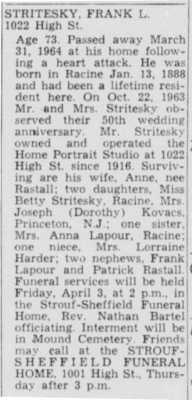 These images were taken by Frank Stritesky who operated the Home Portrait Studio at 1022 High Street in Racine from 1916 through his death in 1964. Frank and his wife Anne were of Bohemian ancestry, and they lived in one of the largest Bohemian neighborhoods in the US, so this collection is likely a great snapshot of that population as well as hopefully showing how the neighborhood changed over the nearly 50 years the studio was in operation.
 what’s left over when the emulsion is damaged. It’s likely what’s left over when water gets between the slides and drys in that state, and what’s left behind after it’s cleaned is just clear glass. The emulsion is totally ruined in those spots, and so cleaning it doesn’t really damage the negative further, it just reveals the damage. Given the risk to many of these plates, and the risk of even washing the emulsion, I decided to avoid cleaning the emulsion altogether.
 The first box of the first crate appears to come from 1917-1919. There’s a man in a uniform that was only in-use from late 1917 through mid-1918, and in another a woman is holding a magazine published in October 1919. There is a wedding party in one series of photos, and a good mix of children, family portraits, and individual portraits. Women were often wearing what I would have thought of as Victorian boots, and while smiling would have been very acceptable by this time, many of the adults have more of a scowl than a grin. Especially the men in the family portraits! There are quite a few men in uniform, right around the time of WWI.

