How to make the most of your AncestryDNA matches: Part 2 – Leveraging your strongest matches to make quicker work of your more challenging matches!

How to make the most of your AncestryDNA matches: Part 2 – Leveraging your strongest matches to make quicker work of your more challenging matches!

Last week we discussed the (very!) basics of DNA testing, and we’re going to take that jumping off point and walk you through how we identify our AncestryDNA matches.

So, congratulations you got your test results back! Now what?

Check out our Ethnicity, and then move on

We wrote extensively why Ethnicity is not a valid part of genealogy and it often does more have than good (It’s time to stop giving attention to “Ethnicity” and genetic admixture), but everyone wants to look at it first (including us!), so give it a read through…and then be done with it. You can go back when you’re bored, but for now let’s get to some real work!

Export your results to GEDmatch

AncestryDNA has the largest DNA database, and the largest set of trees to help establish DNA matches, but their toolset isn’t even basic. Their tools are essentially non-existent. GEDmatch is a free site that provides a great tool set, and results there are used for some of the most important tools you’ll use as you progress deeper in mining your DNA matches. Plus, tests from all of the major sites can be compared on GEDmatch, so you will find 23andMe and Family Tree DNA kits matched to your AncestryDNA there. You’ll also get direct email addresses to your match!

Fair warning however, this is a publicly accessible database that’s specifically used to allow strangers to find your DNA and match it to theirs. This is the tool that’s being used by law enforcement to close cold murder and rape cases, and some people are worried about how publicly accessible their data may be. We don’t share those concerns, and we’re comfortable with their privacy policy and we know we can permanently take our data down if we want to (they do NOT share your raw DNA data, only provide matching segments), so the work we can do there is worth the trade-offs. We wrote about this when the Golden State Killer was ID’d off of GENmatch (Family History is a hobby…but DNA is serious business).

Assuming you want to move forward, we suggest that you start the transfer process first thing since it will take a few days for GEDmatch to full analyze your Raw DNA data.

To download your data from AncestryDNA, follow the instructions here: Download your DNA results

To upload your data to GEDmatch, follow the instructions here: Upload your AncestryDNA results to GEDmatch

We’ll come back to GEDmatch in a future post in this series, as we dive deeper into some of the great tools available there.

Evaluating your matches

Now, let’s get to the first matches! That first look at what’s likely to be 2000-3000 DNA matches is overwhelming, but we’re going to break everything into smaller and smaller bits until we can really start to leverage these matches.

If you followed our Part 1 advice of building our your tree to your 4xGGP, with any luck you’ll now have matches with “Hints” (indicated by the little shaky leaf next to the “Match” button). In the “Filter’s” section, click on Hints, and it should show you only your matches with the shaky leaf. When you click “View Match” button, the path of connection between you and your match should come up.

Screen Shot 2018-12-08 at 8.25.49 PMIn the example to the left, our Most Recent Common Ancestor (MRCA) is our Great Grandparents, and Ancestry has mapped out each of the steps between us. Given AncestryDNA’s limited tool set, we only have a few ways to successfully build out our matches. The first of these was Hints, the next one we’ll use is “Notes”

How to use “Notes” to quickly identify your matches

There are literally a million ways of using the Notes fields in AncestryDNA, and we don’t claim this to be the best way…or even a good way. It’s just the way we’ve found most helpful.

For each MRCA we assign a Line #, and in this example Charles and Rhoda Smith are Line 11. This is the note we’ll use:

Rick-MMF (Not Researched, Charles Henry Smith and Rhoda Upper) – Line 11

Which breaks down as:

  • Rick-MMF – We do our genealogy from the standpoint of our son, Michael, and so this helps quickly identify that the match on Michael’s Father’s Mother’s Mother’s Father’s line.
  • Not Researched – Ancestry, or other quick research like a “Notes” entry has said this is a match, but we haven’t gone through yet and confirmed the genealogy nor have we added this match to our tree yet.
  • Charles Henry Smith and Rhoda Upper – The Most Recent Common Ancestor (MCRA) between us and our match.
  • Line 11 – The line # for these MCRA’s.

These notes help us quickly identify the MCRA for unmatched DNA matches, they quickly identify the matches we need to work to make official, and they give us line numbers we can use later to search for all matches with the same MCRA.

An example of how we use these Notes

After we’re done identifying and validating all of the DNA matches with Hints, and we start trying to identify how other matches tie into us, and what we can learn from those ties, we’re going to start with some very limited ways to identify the MCRA and/or the path to that MCRA. In this example we have a DNA match that has an unlinked Public tree, but with a strong 48 cM of shared DNA.

Screen Shot 2018-12-08 at 8.58.50 PMWhen we click through to the test page, and select the unlinked tree, we find a dead-end: everyone is Private.

Screen Shot 2018-12-08 at 8.54.50 PM.pngIn GEDmatch we’d have a series of tools we could use to narrow down this match, but in AncestryDNA we can’t tell if this match is even Paternal vs. Maternal. But, if we go into the “Shared Matched” and look for any kits listed there that have a Note, we can click the note and see who they match. In this case, they match our Lila Miller match, which has the note we made before attached, so we know this match also is likely to be on Rick’s MMF’s line, and that they are also on Line 11. We will make the same note in this match, and return to our searching.

Screen Shot 2018-12-08 at 9.03.21 PM

These notes will be invaluable as we get into the next installment of “Making the Most of your AncestryDNA Matches”, and use Ancestry as deeply as we can to build out/prove our family trees.

Until next week, update all of your Hints with the proper Notes, and we’ll start blazing new trails!

How to make the most of your AncestryDNA matches: Part 1 – Getting started

How to make the most of your AncestryDNA matches: Part 1 – Getting started

As we approach Christmas 2018, and given the massive push to have cheap DNA tests given out as gifts this season, it seems natural to finally write a series on how to make genealogical use of a DNA test you, or your loved one, may have just taken.

We’re going to start with the very basics on how DNA testing works, and walk through both how to leverage AncestryDNA to track down ancestors as well as using GEDmatch and other advanced tools to go even deeper.

Assuming you have a few weeks before the test results are in, here are a couple of things to learn and prepare before you dive into the matches.

  • First, understand that while the commercials like to highlight the joys of learning your ethnicity, DNA testing raises serious issues that will likely come up as your journey progresses. You may uncover family relationships, both inside and outside of your family, that could have serious negative impacts on people. We’ve uncovered children born outside of marriages that were never known to the family, and we know of adopted children who were outed by tests where their parents had never told them. We wrote about an example of this last year (Dangers of DNA Testing).
  • Second, they key to effectively making matches will be a good, solid family tree through the test subject’s 4x Great Grandparents. Most of your matches made will be through 3x or 4x GGP, and in a perfect world the match will also have a good tree so the link will be obvious. We can’t over state this, or stress it enough: your success/failure of matching DNA tests from unknown relatives will rely on the quality and depth of your tree. We’ve walked through how to build a good “quick and dirty” Public tree on Ancestry (Building a good Public Ancestry.com tree – Part One: sources, citations, facts, and proof), and the process would be about the same on other sites, many of which are free.
  • It’s also important you have the tree available publicly…many of your interactions are going to be about exchanging trees to build a match. It’s ok if you have just a skeleton tree with basic information(names, date of birth/death, locations, children, etc.), but it will be key that you have something available publicly. 

Basics of DNA

The main new term/concept you’ll need for effective Genealogical DNA research is a measure of distance: centimorgan (cM). Now, it’s not technically distance…but for all intents and purposes, it’s used as a measure of distance.

What does cM measure?

Centimorgan measures length of DNA strands. More specifically, it will be used to measure the length of matching DNA segments between your test and a test that is a genetic match. For example, you have roughly 6800 cM if you take all 22 chromosomes and strung them out end-to-end, and your matches will have varying levels of matching DNA, measured by centimorgans.

How do we use centimorgans to identify matches?

Since you get about 50% of your DNA from each parent, your DNA tests will match a test from your parents with about 3400 cM. You will match a Grandparent with about 1700 cM (50% of your parent’s 50%). The more cM you match someone, the closer a relative they are, and the more likely that you will confirm a match with them. 

We’ll use both charts from ISOSG (The Shared cM Project table) and an interactive version of that chart from the DNA Painter site (Shared cM Interactive Tool), which both break down the average cM to expect with various relatives, and helps us identify where to look to establish a match. For example, if a match is 311cM then we can guess they match the person with the DNA test at around a 1st or 2nd cousin…which means our common ancestor is likely a Grandparent or Great Grandparent, which narrows down our search!

What’s next?

So, there’s the first part of this DNA journey. There’s a little homework while you wait for the test results, a basic understanding about how we’ll actually leverage the DNA to make matches, and why your basicGenealogy and a solid family tree will be key to this process. Next week, we’ll go over what to do when you first get your DNA results!

Next installment: How to make the most of your AncestryDNA matches: Part 2 – Leveraging your strongest matches to make quicker work of your more challenging matches!

Matching unmatched DNA matches by Casting a Wide Net, Part 6 – Our crazy attempt to leverage 288 DNA matches to expand our tree comes to it’s conclusion

Matching unmatched DNA matches by Casting a Wide Net, Part 6 – Our crazy attempt to leverage 288 DNA matches to expand our tree comes to it’s conclusion

In the five previous parts of this series: We identified a plan to tackle what looked like a large group of DNA matches (Part 1), we went through and tagged all 288 of our Ancestry DNA results that were related to a group of matches that had Woodley/Woodson surnames in their attached trees (Part 2), we then built out a common tree for as many of the matches as we could, to nail down common ancestors, and to gain clues on where these matches link up with our tree (Part 3), we used GEDmatch and DNApainter to target the most likely line of “Mary’s” that leads from her to the group of 12 DNA matches (Part 4), and last week we broke through a brick wall with some old fashihttp://anamericangenealogy.com/2018/08/06/matching-unmatched-dna-matches-by-casting-a-wide-net-part-3-building-a-single-tree-using-all-of-our-dna-matches-public-trees/oned genealogy (Part 5). In this installment, we wrap up the story of this journey and the lessons we’ve learned.

This journey also highlights the paradox of genealogical DNA: Your matches will come easiest on lines where you have a complete and accurate tree, but you’ll struggle to match those that are on the lines where you really need the help of DNA…because you don’t have a complete and accurate tree.

As we ended our last installment, we’d identified Sam Caswell’s wife as Annie (Moore) Caswell, daughter of Robert Moore and Henrietta (Bradford) Moore. We were able to quickly identify Henrietta’s mother, Sallie Bradford and five of Henrietta’s siblings. It was amazing, the links came easy, and the tree fell in-place just how you’d hope. The only problem was…we weren’t getting any closer to linking Roman and Mary Jones to “Mary”.

Screen Shot 2018-08-10 at 3.18.43 PMGoing back to our work with the “What Are the Odds?” tool (Part 3), it’s 48 times more likely that “Mary” and Roman/Mary’s Most Recent Common Ancestor was our “Mary’s” 3x Great Grandparents, than it was her 2xGGP, and 77 times more likely that it was 3xGGP v. 4xGGP. That means Annie (Moore) Caswell’s parent all but needed to be the MRCA. One thing became increasingly clear as we shrubbed out our tree with the new information: Sam and Annie weren’t a link to Roman and Mary Jones.

Roman Jones was born around 1840, and his wife Mary was born around 1838. Annie (Moore) Caswell parents were both born around 1880, and for them to share parents would be…incredible. We looked back a generation (hoping to defy the 48 times odds!), and the lines still didn’t match.  We had good info on “Mary’s” 4xGGM Henrietta Bradford and her siblings…and while we couldn’t rule it completely out, it was very likely she wasn’t a link to the Jones either.

We went back to review everything we had on Annie Caswell, and in the 1910 U.S. Census it jumped out at us: Sam and Annie listed themselves as having no children, despite the fact that Mattie would have been 7 years old. She also indicated that she never had children.

SamAnnie1910Census

When we looked at our notes, and research we realized we fell in the most basic trap in genealogy research: we had accepted family lore as fact, and built around that “fact”. We had an uncle that had done some basic Ancestry-based research, and when we first built out a skeleton tree, we’d used his info as the bones of the Caswell line. We had all the right facts on Mattie Caswell, we had all the right facts on Sam Caswell and Annie (Moore) Caswell…but we’d never proven their link. We went back and reviewed the transcripts of other family interviews we’d done with Mattie’s granddaughter (and others) about 4 years ago and there it was. They described that Mattie’s mother had died soon after Mattie’s birth, and her father died soon after. Mattie had been raised by others, her parents weren’t Sam and Annie, and the brick wall we’d broken through wasn’t ours…in-fact it wasn’t anyone’s, since they never had children who would be researching their ancestors.

So what did we learn in all of this?

  • The crazy strategy of casting a wide net across 288 DNA matches worked..even though it was a LOT of work.
  • We identified a key ancestor, and we know where we can expect the MCRA to fall in our line once we know more about our line.
  • In the end, no matter how high-tech genealogy research becomes with DNA, it still comes back to the basics of a solid tree, with strong evidence, supported by old fashioned family history research. Without a solid tree, we can’t take full advantage of DNA links.

This journey also highlights the paradox of genealogical DNA: Your matches will come easiest on lines where you have a complete and accurate tree, but you’ll struggle to match those that are on the lines where you really need the help of DNA…because you don’t have a complete and accurate tree.

For us, it’s back to the drawing board. We’re spinning off the branch of the Caswell tree for Sam and Annie that we’ve documented so well, and making it Public so others can benefit from our work. We’re attempting to identify more information from family on where/when George Barnes and Mattie (Caswell) Barnes died, so we can get their Death Certificates and begin working backwards again!

Matching unmatched DNA matches by Casting a Wide Net, Part 5 – Rolling up our sleeves and doing some genealogy

Matching unmatched DNA matches by Casting a Wide Net, Part 5 – Rolling up our sleeves and doing some genealogy

In the first four parts of this series: We identified a plan to tackle what looked like a large group of DNA matches (Part 1), we went through and tagged all 288 of our Ancestry DNA results that were related to a group of matches that had Woodley/Woodson surnames in their attached trees (Part 2), we then built out a common tree for as many of the matches as we could, to nail down common ancestors, and to gain clues on where these matches link up with our tree (Part 3), and we finally used GEDmatch and DNApainter to target the most likely line of “Mary’s” that leads from her to the group of 12 DNA matches (Part 4). In this installment, we use take the high-tech leads we have and do some old-school genealogy to try and prove out our theory on who connects us to Roman and Mary Jones.

Given what we knew, it’s most likely that Mary matched the other 12 through a 3x Great Grandmother on her mom’s side. Of course that’s two women…neither of which we know much about: Fannie (Johnson) Barnes and Annie (–?–) Caswell. We had some decent confidence in who Fannie’s parents were, and the family originated in Tennessee. Since Roman and Mary Jones were from NW Mississippi, we decided to focus in on Annie Caswell from Quitman County, MS.

Mattie's Tree

Sam and Annie Caswell, when we started this process

We had almost no information on Annie Caswell. We didn’t know her maiden name, her actual birth year (only Census year), her death year, or her parents’ names. We did have her husband’s death month, year and location, and so we decided to order Sam Caswell’s Death Certificate and hope that would be enough…and that maybe there was more information on Annie listed.

Mississippi is horrible when it comes to Vital Records. They didn’t start requiring any Birth or Death Records to be recorded until 1912, and wide adoption by counties wasn’t complete until the early 1920’s. Additionally, they spent decades trying to dehumanize people of African descent to the degree that the less they were recorded as people, the better. On top of that, what they did record is mostly neither online or microfilmed…or even indexed.

There is no question DNA testing/results are valuable, but in the end it’s still just genealogy and the same techniques that have been used by family researchers for a 100+ years that are going to break through your brick walls.

This is one of the reasons there are so many holes in this branch of our family. We haven’t made the genealogy pilgrimage to Mississippi, we’re not sure what we’ll find when we get there, and there’s next to nothing available remotely. Facing this, we decide to attempt our first MS Vital Record purchase online…which requires “VitalCheck”.

About 2 weeks later, after having to remember just about every address we’ve had in the past 20 years to get past VitalCheck and deciding that selecting “Grandchild” for our relationship when we really meant “maybe 2nd Great Grandchild” was the same thing, we received Sam’s Death Certificate in the mail.

We were hoping that Annie was still alive at the time of his death, and that the certificate was filed out with her maiden name listed (maybe?). The bad news is, none of that was true…but the good news is that it gave us a next step.

We know that Sam and Annie were married in the 1940 U.S. Census but by the time of Sam’s death on 4 Jul 1974, he was married to Emma (Fox) Caswell. Of course, we’re not even 100% sure this Sam is the same Sam from Sam and Annie in 1940, and now we have a different spouse listed on the birth certificate. But, it’s possible that Annie died after 1940 and Sam remarried. The problem was how do we find Annie and tie her to Sam, let alone find her maiden name.

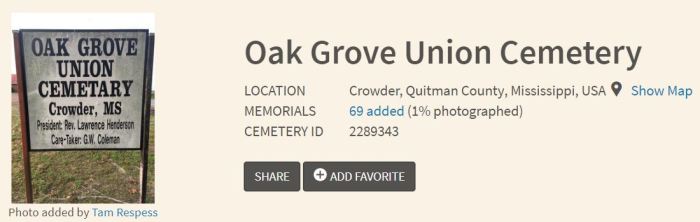
The hint we needed came from Sam’s Death Certificate, and his burial location. He was buried in an African American cemetery in Quitman County, which like most Southern Black cemeteries, is poorly documented. Looking in Find-A-Grave, we saw that only 1% of the headstones here were photographed, and there was no record of Sam’s

OakGroveCemetery

headstone/burial. However, looking at the other Caswell’s in Oak Grove Union Cemetery, we found a major lead: Annie Caswell, b. 15 Sep 1882, d. 11 Jul 1969. We’re well into speculative territory here, but this Annie first the proper birth range and she died before Sam.

Needless to say, the next step was to order our 2nd Mississippi Vital Record from the Mississippi Department of Health. But it highlights something we’ve known for quite some time about Genetic Genealogy, but it’s easy to forget: There is no question DNA testing/results are valuable, but in the end it’s still just genealogy and the same techniques that have been used by family researchers for 100+ years that are going to break through your brick walls.

We’ve shown how we can use things like DNA testing and GEDmatch to give us leads researchers would have NEVER had 20 years ago…but in the end, only the basic work of gathering and confirming Birth/Marriage/Death records will turn the leads into family members.

We received Annie Caswell’s death certificate, and it was the goldmine we were hoping for! She was married to Sam Caswell at the time of her death, and her mother’s maiden name was listed. We had gotten back a generation, both parent’s names, birth date and location…everything you could hope for! Unfortunately, her mother’s maiden name wasn’t Jones…it was Henrietta Bradford. That means Mary’s 3x Great Grandmother wasn’t a Jones, by name. It would have been much easier…but it’s possible that the 4x Great Grandparent we expect will be the link to the Jones family was Henrietta’s mother.

AnniesParentsName

We’ll conclude this series next time, as we shrub out Henrietta’s tree…and reach the end of this journey!

Next in the Series:

Matching unmatched DNA matches by Casting a Wide Net, Part 4 – Proving the matches, and establishing a theory of connection

Matching unmatched DNA matches by Casting a Wide Net, Part 4 – Proving the matches, and establishing a theory of connection

In the first three parts of this series (Part 1, Part 2, Part 3), we went through and tagged all 288 of our Ancestry DNA results that were related to a group of matches which had Woodley/Woodson surnames in their attached trees. We then built out a common tree for as many of the matches as we could, to nail down common ancestors, and to gain clues on where these matches link up with our tree. In this installment, we leverage GEDmatch, and deductive reasoning, to identify where we think our tree will link up with their trees.

The largest DNA matches (by centimorgans) we identified in Ancestry had also uploaded their DNA results to GEDmatch, so we were able to do tests to confirm they all truly matched. The “One-to-One” matches for each of them confirmed they were all related to “Mary”. It’s not scientific to say that all 288 were actual DNA matches, but we know the core group of matches are and that a good number of the matches-of-matches are likely also legit.

X DNA is tricky, but the important use of it identifying people who you CAN’T be a match if you share X DNA.

We were also able to use GEDmatch to identify the “true” cM match amounts between various matches, and from there we leveraged the International Society of Genetic Genealogists’ table showing cM ranges and averages between various family relationships (Shared cM Project – V3). The closest match for Mary was “W.W.”, and we settled on 133cM as their match level. The most likely relationship for that level of match was with a shared Great Grandparent, with W.W. likely being a 2nd Cousin, or a 2nd Cousin Once Removed. When we fleshed out the other 12 matches on paper, they all roughly fit this notion that they matched either Mary’s Great Grandparent or Great-Great Grandparent.

female-x-chart
Inheritance pattern for females (X DNA)

The other thing that jumped out at us, unexpectedly, from GEDmatch was that some of the 5 matches there had X DNA matches as well. X DNA is tricky, but the important use of it identifying people who you CAN’T be a match if you share X DNA. For example, a person will only inherit X DNA from their mother, so if you have an X DNA match that you’re theorizing is related to someone, but there are two male relatives in a row between the two matches, that isn’t possible.

Once we built out the theoretical map between all the matches and Mary it all fit that her GGP’s could be Roman and Mary Jones, and with the DNA levels and inheritance pattern of X DNA it’s likely that Marie’s relative was a daughter of Roman and Mary. It also pointed strongly to the matching being on her mother’s side.


Screen Shot 2018-08-10 at 3.18.43 PM
“What are the Odds?” gives you the chances of various hypothesis’

The day after we did our work on paper with the ISOGG chart as our guidance, DNAPainter introduced a new tool called “What are the Odds?”  that does the same work we just did on paper! It’s easy, it’s awesome, and we’ll cover it in more detail in a future post. But, most importantly, it showed us that it was 77 times MORE likely that Roman or Mary Jones’s parents are our Most Recent Common Ancestor, than anyone else. It’s technically possible that our Mary is directly descended from Roman and Mary Jones, or that they are connected by 4xGGP’s…but it’s much, much more likely we’re looking for Mary’s 3xGGP’s, the parents of Roman and Mary.

Looking at Mary’s tree, and she of course has 2 maternal GGM’s. One, we have some documentation (mostly Census info with Ancestry Member Trees), but the other we had almost no information. We’re guessing the one we have little information on, Annie Caswell, might be the best lead, so we’re going to dig into her.

Samuel and Annie Caswell were born, married, and died in and around Crowder, MS. Family lore has Sam and Annie as Mary’s grandparents, but we only have Annie’s Census birth date, and no maiden name for her. About the only piece of hard information we had was that Samuel might have died in July 1974 (based on the SSDI).

Time for some old-school genealogy, to hopefully prove out the high-tech theory that points to Annie Caswell being on the Jones line.

Next in the Series: Matching unmatched DNA matches by Casting a Wide Net, Part 5 – Rolling up our sleeves and doing some genealogy