I’m a huge advocate for Public trees in Ancestry.com. Private trees have often been the bane of my existence. I still plan on a post about why I feel we all have a duty to share our research publicly. But, as of today, most of my trees are now private and unsearchable, and it was the right choice.
I wrestled with this for a couple of weeks, but once I found that my trees were getting picked up in Ancestry’s predictive tools (Ben Franklin, and how We’re Related took me from chasing my white whale, to chasing my tail) which ignore all of my warnings about how unreliable my “Working” trees are, I started to understand I probably had to bring these tress undercover.
It’s easy for others to filter out weak research on well documented lines, but on lines with little data, it naturally more likely for undocumented “facts” to get attached to other trees.
This week, I found a new Ancestry tree that contained a bunch of GREAT information on my Leonard line. The user even found my 3x GGF headstone in a little catholic cemetery that my wife and I have been to 3-5 times but we couldn’t find it. It looks like the headstone was dug out of the earth! There was a ton of original research I’d never seen, or had index of, and I was so happy we had a new research expert on this line. Then, I saw that he had relatives past my 2x GGM, who is a major brick wall for me!! This is a well researched tree, great original work…and one of my Working/Uncertified trees was the source of this “breakthrough”. Later, I found that another of my wildly speculative ancestry guesses was in his tree, looking very definitive. One of the comments on my previous post talked about how a reader had their work republished over and over until it became “fact”, and here I could see that happening to mine.
My warnings/qualifiers on my speculative trees aren’t enough for humans, and useless for automated algorithms
It’s just too easy for my speculative work to get pulled into trees, that feed other trees, that get repeated so often it’s impossible to determine the source. This is especially true for lines where there’s little to no other data…which is why I’m building a speculative tree in the first place. Very quickly my tree becomes the only reference to these undocumented ancestors, which means it gets found as a “breakthrough” by others who are stuck, which makes it more likely to become authoritative. It’s easy for others to filter out weak research on well documented lines, but on lines with little data, it naturally more likely for undocumented “facts” to get attached to other trees.
So, for now, I’ve taken most of my trees out of the mix on Ancestry.com. It’s hard, and I’m not entirely comfortable with this, but for now I think it’s best.
The verdict? This could turn into a very useful tool. More and more Ancestry is guiding us towards bringing out more of our ancestor’s stories, as opposed to just standard genealogy, and this is a successful part of that effort.
I noticed this morning that my DNA Homepage had been updated…and a new feature had been added (in Beta): Genetic Communities.
Under what’s now termed Genetic Ancestry and in addition the Ethnicity Estimate, there’s now a section called Genetic Communities.
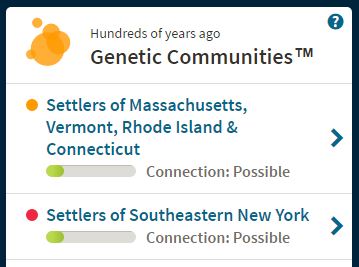
When you click through to Genetic Communities you’re presented with the communities that Ancestry has calculated that you, and member matches that share ancestors with you, belong to. The information presented can be a bit general, but it does provide pretty accurate/helpful historical context. For me, I was presented with 2 “Possible” communities that I could belong to:
In clicking through the Settlers of Massachusetts, Vermont, Rhode Island & Connecticut community, I saw some pretty cool graphics:
The migration lines are animated, and you can see some of the stories that support the idea of a community on the left side pane. If you click a time frame in the left pane, you’ll get a small write-up on what that time encompassed as well as showing how many of your relatives are potentially covered in that description. Additionally, you’re shown graphically where your connected Member Trees have ancestors during that time.
If you click on the list of users from your family tree, you’ll see the list of your ancestors who lived in the covered area, during the covered time.
As you scroll through each time span, you’ll be able to see a representation of how your ancestors, and some of your connected relatives, migrated as time went on. You’ll also get more information about the events and context surround those time periods, as well as a complete list of your relatives who match this classification.
If you go back to the main page for your community, there’s an option to show “Connection” and clicking that will give you more information on your family tree:
I clicked Connection and it details how sure Ancestry.com is that I fit an identified community:
On the lower part of the screen, you can see they have grouped your DNA matches between you and the broader community, as well as the last names associated with your lineage.
There is definitely a LOT to click through and enjoy. For instance, each time period has a listing of “Historical Insights” at the bottom that will help give you broader information about what was occurring during that period.
The verdict? This could turn into a very useful tool. More and more Ancestry is guiding us towards bringing out more of our ancestor’s stories, as opposed to standard genealogy, this is a part of that effort.
My family line is heavy on English settlers to Massachusetts in the early-to-mid 1650’s, and Genetic Communities identified that successfully, but since I know this era relatively well it was easy picking out some less than accurate facts that were attributed to my family. Ironically, the tests from Felice’s Grandmother were much more accurate and helpful.
It’s not the case usually that any area of African American genealogy is more complete than white genealogy, however Felice’s grandmother quickly showed a “Very Likely” match to the African Americans in North Carolina community.
As you can see, her community is pretty well established and is Very Likely to return matching records. Reviewing the notes that go along with this community was fascinating, and will likely help my work to further her line. I didn’t understand the prevalence of the West Africa/North Carolina flow of slaves, and it helps explain why so many references to North Carolina appear when tracing her various relatives, even though her family has very few ancestors in the state from 1850 onward.
Just like with my line, however, the general nature of the historical notes is pretty clear as the migration patterns and experiences of this group in general gives way to what we know about her family in fact.
So, my first impressions are that this is major new feature that delivers very interesting information, and helpful context and general information about both my lines and the lines of those related to us, but it likely will need further refining to bring it’s true value into clearer focus.
If you haven’t used the “We’re Related” app from Ancestry, you should give it a try. It seems a little silly to begin with, but there’s some value to it (a previous post: We’re Related app is a lot less frivolous than it first appears). But a recent tip from the app seemed to lead me to breaking down a major brick wall, before I realized I was fooled by my own published research.
First, a little background on my brick wall. The Tradewell (it was actually Treadwell prior to ~1840) line is one of the trunks of my family tree growing up. We all have those, the handful of family lines that dominate our history and identity when we’re growing up, despite having 8 Great-Grandparents, the Tradewell line was one I knew a lot about growing up. Its also the line that has a lot of genealogical significance, because my Great-Grandmother Myra (Tradewell) Morse submitted her first DAR application in 1907 and that not only gives me a lot of information on this line, subsequent cousins and relatives who applied attached sworn copies of family bibles to their applications, which preserved a great deal of info that otherwise would be long lost to history.
But Myra’s line ends with her Grandfather, and he is only one of two 3x GGP’s in my line that end so early. James Bennet Tradewell died in my hometown of Racine, WI in 1885, moving here just after 1840 from Schoharie County, NY. The 1830 Census includes an older Rueben Treadwell living in Schohaire County along with two younger Treadwells, Ephriam and James B. In 1840, Rueben is no longer listed but James and and Ephriam are. By 1850, from my research and from census records, there are two men in South East Wisconsin named James and Ephriam Tradewell who were born in New York, and those two names are also not present in New York for the 1850 Census. So even making a guess that Rueben is James and Ephriam’s father, and that James and Ephriam moved to Wisconsin Territory around 1843, I can go no further. I have very little evidence of even those links, and the line beyond Reuben goes dead.
I’ve also done research on the broader Treadwell line, which is largely threaded through Thomas and Edward Treadwell who arrived from England in the 1630’s and their decedents settled mostly in Connecticut and New York. My current working theory is that Jacob Treadwell and Hannah (Trowbridge) Treadwell are the parents of Reuben, but I have no proof whatsoever that this is true.
I created a “Working/Uncertified” for the Tradewell tree, to match these two half into a theoretical whole that I hoped would spawn some “shakey leaf” hints on Ancestry.com, and to further my research. Unfortunately, that didn’t work. I still have no clue as to the names of Jacob and Hannah’s children, nor who Reuben’s parents might be, so it’s one big brick wall.
Until, as I was waiting in line at the grocery store and scrolled through my latest We’re Related matches and I see Ben Franklin. When I expanded the link, I almost fell over when I saw Hannah Trowbridge connected to Reuben Tradewell who was in-turn connected to James Bennet Tradewell! I was stunned…this app that links me mostly to celebrities I couldn’t care less about had just broken down one of my top-5 brick walls!!!
I was giddy as I got home, made dinner, begrudgingly hung out with my family, until I was finally free to do a little research. I did a search on Public Trees for Hannah Trowbridge, with her husband’s last name set to Treadwell and I hit pay dirt! Right away I see that all of the children I’d guess were theirs were also listed. I looked at the attached facts, and didn’t see anything that linked the children to the parents, so I decided to review the Ancestry Family Trees to see if the trees that were sourcing this tree had more facts than this.
And that’s when I realized I wasn’t harpooning my white whale today, and wasn’t related to Benjamin Franklin. My Working/Uncertified tree was the source of the link!
The We’re Related app had built a link between myself and our common ancestor using the data available, and it turns out that my test tree was the only link. And since the algorithm doesn’t read the titles of trees, or the description that I attached to the tree, it treated it as a valid, proved link.
I’m starting to re-think my strategy of keeping my Working/Uncertified trees Public. I’m a big supporter of keeping our trees Public, but in this case not only did my strategy fool the app, there are several user trees that now have this link shared as a fact. As time goes on, and these electronic records are shared, and re-shared, and memorialized outside of Ancestry.com, I’m afraid I’ve introduced misinformation into this family line.
I’m not sure why I first downloaded We’re Related, but it felt rather silly. Almost immediately the app is telling me I’m related to Madonna, Johnny Depp, and Bill Clinton which seemed like a gimmick. And, let’s be honest, it comes off more as a marketing tool than genealogy tool.
But to discount this app is to be missing out on some decent family history research opportunities as well as missing what could be the dawn of a great new tool in genealogy!
If this technology is ever leveraged against some of my brick walls instead a gimmick like linking me to Blake Shelton, Ancestry might really be on to something.
The feature that I’ve found most useful, and that I wish was more available in Ancestry.com, is the projection of relationships beyond what you’ve identified in your tree. The tool collects data from other sources and makes an educated guess about your direct ancestors and presents them as a line that happens to match the line of a celebrity. This conjecture is like a “shaky leaf” hints taken to the next step. Instead of using the data you’ve entered that matches either what another Ancestry member has entered, or a fact match that shares the same information as you’ve entered into your tree, We’re Related will build out your tree using your information as a starting point, and try and build a map that uses the best available data to connect your line to another. The potential power of a tool like this, when properly executed, is what excites me…much more so than potentially sharing ancestors with DJ Spider One.
Using my match with John McCain as an example, let me show you what I mean…
This is the first match I decided to trace and see if I could prove out the connection, and given that I have several DNA lines that are proved that are 7th Cousins or above, it seemed like I’d have a good chance of mapping it out.
As I expected, I’m several generations older than Sen. McCain so I had more ancestors to prove. Clicking the link showed that James Morgan was on my Father’s, Mother’s, Father’s line which is well documented. I wasn’t aware of the Morgan name previous to this, but when I started tracing back I quickly recognized my 5xGGM Mary Goodwin.
From here I just followed the shaking leaf hints back to James Morgan. My main tree is a Working/Uncertified tree so I’m pretty liberal on the sources I accept to establish facts in the tree. I stay away from Ancestry member trees, but I’m comfortable using secondary or greater sources like those in the Lucius Barnes Barbour Collection (a collection of records as transcribed by Lucius Barnes Barbour in the mid-1800’s) and the Family Data Collection (genealogical data gathered for scientific study that was not properly documented, and set to be destroyed, before it was saved and entered into an electronic database) despite the risk that the data isn’t very accurate. It’s not unusual for there to be transposition of dates, or years like 1703/4 trimmed to 1703, but by and large the overall information is accurate, if not enough to be considered genealogical “proof”.
I was able to establish the link from Mary Goodwin to James Mason just following “shaky leaf” hints, and this demonstrates how this could be a powerful genealogical technology. Unlike the shaky leaf hints, which are based on the top 10% of most used sources, and are closely tied to information you’ve already entered on a relative, We’re Related is making suppositions based (apparently) on an algorithm that can draw the line between what you know, and what it guesses is true, to build a potential line for you.
In this case, the system’s supposition was accurate, and it helped me build a link that I hadn’t built. I have other examples, which I’ll write about later, where those suppositions weren’t accurate. But if this technology is ever leveraged against some of my brick walls instead a gimmick like linking me to Blake Shelton, Ancestry might really be on to something.
Until then, We’re Related is more than just a gimmick, and if you get lucky, you might accidental solve a family mystery.
There’s a saying that goes back to the original dot com boom: If you aren’t paying for the product, you are the product. In modern Genealogical research, it’s important to know that not only are you (and your data) the product, you are usually also paying for the product!
In many ways genealogy hasn’t changed much since the explosion of family history research in the late 1800’s. When my Great Grandmother Myra (Tradewell) Morse completed her application for membership in the Daughters of the American Revolution in 1904 she leveraged many of the same resources I use today: vital records from various courthouses, cemetery research, family heirlooms (like bibles), and Federal military service records. Those sources are largely still available to me today, and I can pursue them just like she did, largely without the involvement of any other group.
However, modern genealogical research makes MANY more sources available to you, and you can do more research in a short period than Myra Morse could have done in her entire lifetime. But most of these new sources come with a catch: to use them, you are often serving someone else’s agenda, for better or worse.
Some of the tradeoffs are common and obvious. Ancestry.com needs more subscribers to have the content necessary to attract more subscribers, so your $19.99/month is not as valuable to them than your contributions to the community. Some of the links however, aren’t as obvious.
Newcomers to genealogy are often struck by the high level of involvement by the Mormon church. Many of the documents that have been microfilmed/digitized over the last century were sponsored by the Mormons, who also have both the largest family history library on the planet (FHL) and the worlds largest network of branch libraries lending many of those collected materials.
I have at least 10 Family History Centers within an hour of my house. Thanks Church of Latter Day Saints!
It seems that everywhere you turn, there’s further Mormon involvement in this journey, however, that’s not because the church supports this hobby per se, or that one of the founders was interested in genealogy so the church picked up that interest. The Mormon’s are heavily involved in tracing family roots due to their doctrine of “Proxy Baptism” which holds that souls that have passed continue to have the ability to make choices, but those souls cannot choose to be Mormon if they died before being baptized into the faith. The Latter Day Saints have built massive, detailed, and accurate family trees in an attempt to identify every person ever born, and have set out to baptize a living church member today as a proxy for identified ancestors who’ve passed away previous to hearing the Mormon gospel. That proxy baptism will grant the ancestor the choice to accept the teachings of the Mormon church, and enter heaven, posthumously.
So, while you have access to a literal treasure of information about your family history (and I mean that…who else would have ever cared about the Mississippi Enumeration of Educable Children, 1850-1892; 1908-1957 and microfilmed it for me so I could solve huge mysteries about one branch of Michael’s family tree!!!) you have to understand that the work you do with that information will eventually, if all goes to plan, result in your ancestors being baptized into the Mormon faith. For some that’s an issue (A Twist on Posthumous Baptisms Leaves Jews Miffed at Mormon Rite), while for others there’s no concern about their ancestors potentially having another choice of savior after death. Either way though, it’s probably best to understand the motivations behind the groups “helping” you in this process, to make sure that you’re comfortable with the direction they’re helping you pull.
Another tradeoff you’ll likely face is related to DNA testing. DNA testing is an amazingly powerful tool that will only continue to revolutionize genealogical research. While DNA testing comes with it’s own challenges (Dangers of DNA Testing), the testing companies add another level of concern when it comes to these home testing kits.
AncestryDNA has become the major revenue generator for Ancestry.com, and 23and Me’s entire business model is based on the money made from genealogical DNA testing. However, that revenue isn’t generated by the $99/test you pay to have the get your results since that $99 doesn’t even cover the cost of the test. These companies make money selling access to your DNA by various drug, health, and research organizations. The bigger their database, the more valuable that database is, so all efforts are geared towards growing the number of samples they have access to.
Here’s an article from Wired that highlights the true value of the DNA that you paid to have gathered:
The logic behind these partnerships is clear: Companies like 23andMe and AncestryDNA have spent years getting people to swab the inside of their cheeks and spit into vials, and all of those samples are valuable.
The tradeoff for you as a researcher is that while you gain access to an amazingly powerful tool, while at the same time you agree to expose you and your family’s DNA to 3rd party entities that help generate huge profits for AncestryDNA and 23andMe. Additionally, it explains why all of these companies efforts are focused on the flashy “benefits” you get (Ethnicity Estimates and Health Screens), but much less effort is invested in helping you understand the results or how to leverage the results once you’ve given them the DNA data the need.
I have personally done as much opting out of allowing my DNA samples to participate in these for-profit 3rd party research efforts as possible, but we need to understand that they still can sell our data in aggregate and that they can change the terms of the terms and conditions of your sample to ignore your consent in the future. I have seen reports that they have have already completed full genetic sequences (vs. the normal, limited genealogical sequencing) on our samples to specifically provide data for Parkinson’s research. Ironically while AncestryDNA has done the work on the samples we paid to have collected, and have sold that data to big pharma, you can’t even gain access to your own full genomic data! The Terms and Conditions limit what you’ll receive, and you have no rights beyond that.
It’s possible to remove your physical sample from AncestryDNA’s labs, and scrub the information from their database, but then the tradeoff is you’ll have to re-test if new technologies/strategies become available. You will also lose the benefit of your DNA linking you to future tests since you will no longer be in the database. Combine that with the fact that over time you are going to have samples of relatives that have passed away, so samples can’t be re-gathered, and these companies know you’re probably not going to remove your data once it’s in the system.
Just because you’re serving someone else’s agenda, it doesn’t mean that there is malicious intent or that you should avoid those compromises. However, just like it’s important to understand the source of a fact before you accept it and apply it to your ancestors, it’s important to understand the motivations behind those providing some of our modern genealogical records as those records become more and more integral to your family tree.
Menu
Cookie Consent
We use cookies to improve your experience on our site. By using our site, you consent to cookies.
Cookie Preferences
Manage your cookie preferences below:
Essential cookies enable basic functions and are necessary for the proper function of the website.
Name
Description
Duration
Cookie Preferences
This cookie is used to store the user's cookie consent preferences.
30 days
These cookies are needed for adding comments on this website.
Name
Description
Duration
comment_author
Used to track the user across multiple sessions.
Session
comment_author_email
Used to track the user across multiple sessions.
Session
comment_author_url
Used to track the user across multiple sessions.
Session
Statistics cookies collect information anonymously. This information helps us understand how visitors use our website.
Google Analytics is a powerful tool that tracks and analyzes website traffic for informed marketing decisions.
Contains custom information set by the web developer via the _setCustomVar method in Google Analytics. This cookie is updated every time new data is sent to the Google Analytics server.
2 years after last activity
__utmx
Used to determine whether a user is included in an A / B or Multivariate test.
18 months
_ga
ID used to identify users
2 years
_gali
Used by Google Analytics to determine which links on a page are being clicked
30 seconds
_ga_
ID used to identify users
2 years
_gid
ID used to identify users for 24 hours after last activity
24 hours
_gat
Used to monitor number of Google Analytics server requests when using Google Tag Manager
1 minute
__utmb
Used to distinguish new sessions and visits. This cookie is set when the GA.js javascript library is loaded and there is no existing __utmb cookie. The cookie is updated every time data is sent to the Google Analytics server.
30 minutes after last activity
__utmc
Used only with old Urchin versions of Google Analytics and not with GA.js. Was used to distinguish between new sessions and visits at the end of a session.
End of session (browser)
__utmz
Contains information about the traffic source or campaign that directed user to the website. The cookie is set when the GA.js javascript is loaded and updated when data is sent to the Google Anaytics server
6 months after last activity
_gac_
Contains information related to marketing campaigns of the user. These are shared with Google AdWords / Google Ads when the Google Ads and Google Analytics accounts are linked together.
90 days
__utma
ID used to identify users and sessions
2 years after last activity
__utmt
Used to monitor number of Google Analytics server requests