Building a good Public Ancestry.com tree – Part Two: Attaching facts to sources, and using “wrong” facts in your tree

Building a good Public Ancestry.com tree – Part Two: Attaching facts to sources, and using “wrong” facts in your tree

In Part 1 of this series (Building a good Public Ancestry.com tree – Part One: sources, citations, facts, and proof), we talked about some of the fundamentals of how to understand the components of a properly sourced a tree on Ancestry.com. In Part 2, we’re going to talk about a critical way to approach your trees before we walk through putting everything into practice and building your tree.

Attach all sources to the preferred fact, or list a fact for each source? 

There are two schools of thought on how to attach facts to sources online. The most common method is to attach all facts of the same type (say Date of Birth) to the primary Date of Birth, even though they don’t match. The other will link each source with the fact asserted in that source. For instance, my 2xGGF Wesley has an obituary that indicates a date of birth of 16 Dec 1837, and there are census entries that indicate he was born abt. 1836, abt. 1837, Dec 1837, and abt. 1838. The method most people use for their trees would have you set the primary date of birth as 16 Dec 1837, and have the census birthdates attach to that date since it’s primary.

The other approach, and the one we use, is to attach each fact to each source as they are sourced. So, for example, we have chosen 16 Dec 1837 as Wesley’s Preferred birth date and we’ve attached the two sources that indicate that date: his obituary and his family bible. For the 1850 Census has Wesley’s birthday listed as “abt. 1836”, and so we have an Alternate Fact for that, with the 1850 Census attached as a source. The same for the 1860 Census and “abt. 1837”. Repeating the process we end up with 5 dates of birth for Wesley.

Capture3

A lot of people avoid this approach because your ancestor end up with many events like dates of birth, when in reality an ancestor can only have one birthdate, and because all the records can clutter the ancestor’s record. We couldn’t imagine having all the records tied to a single, preferred fact because it would be so difficult having to research each source attached to a birthday in order to find which actually supports that fact.

Here’s an example. While preparing Part 3 of this series, we used an ancestor Ephraim Treadwell as an example, and when clicking through to review the sources attached to other’s Member Trees, in an attempt to resolve a conflict on his place of death, this is what we encountered:
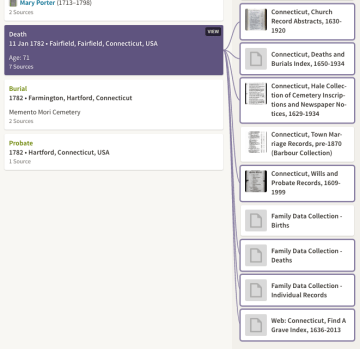
Screen Shot 2017-05-06 at 8.48.31 AM
Why would we search through 7 sources to find out which one has the wrong death location?

This is how every Member Tree was sourced, and looking at his death fact, it seems to indicate that every source supports that date of death and that his place of death is Fairfield, CT. But, in-fact, none of the sources support his death location, and only some support his death day. To determine which sources support which facts, we have to review each source individually. We sure wish they had chosen to link each source to the fact as it was sourced, but by choosing to link all sources to the preferred death fact, we have to dig through each source to determine what those sources actually support.

In the end, we’re big advocates for showing what the sources support, with facts listed as they are asserted, as the best way to get a true picture of the facts that make up your ancestor’s record. Even when those facts aren’t precise, or even correct.

Connect all facts, even when they don’t appear correct 

It’s counter-intuitive that we’d attach facts that we know to be incorrect in-order for us to better understand what’s correct, but when you consider that you can never know the accuracy of any historical fact, it’s hard to support ignoring facts you only think are inaccurate.

Screen Shot 2017-05-06 at 9.10.46 AMTaking a look at Wesley’s father James, we see a range of birth dates that range from 1790-1799. We don’t have a great record that indicates his birth date, but most of what we have clusters around 1796-97. Seeing the range helped when we found a Family Bible entry for James that indicated 11 Aug 1796. Even though the bible entry was completed at some point after 1855, so it wasn’t entered at his time of birth, but we can be comfortable that the date fits the previously known range. It also helps when reviewing early censuses. We reviewed the 1820 Census with the idea that his age would likely be between 21 and 30, but that since we only have one outlying record that shows 1790, it’s likely he’d be <30 years old. It’s also likely his age was closer to 23-24 and it was not uncommon for male children to be living on their parent’s farm at that age. It’s helpful to be able to understand all of that from a quick glance at his record in our tree, instead of having to dig through 9 sources to figure out his birth day.

Only through the complete presentation of all records can you review and identify what facts are likely correct. Because of that, we prefer to present all of the facts as they are sourced, and later interpret what’s likely accurate/inaccurate. If you’re editing as you’re attaching sources, it’s very easy to make the facts fit your current understanding of your ancestor when it might be more appropriate to use the facts to change your current understanding.

In the end neither choice is officially right or wrong, but we wanted to put it out there for your consideration, and to let you know why we will approach facts and sources differently than most other researchers.

In the next installment of this series we’ll get to work and start building a good Public Ancestry.com tree!

TEST DRIVE: My 48 hours with the new Family Tree Maker 2017

TEST DRIVE: My 48 hours with the new Family Tree Maker 2017

I finally was notified Friday night of my eligibility participate in MacKiev’s 48-hour beta test of FTM2017. While I have been, and will continue to be, critical of the process (Mackiev’s latest update engenders even less confidence, puts 2017 release 3 weeks behind with no firm date for release) I was largely happy with the new software, and can’t wait for it to go live.

Listen to their advice: Use a practice/non-critical tree for your testing.

I have over 20 years experience testing software releases (MacKiev 2 weeks late with Family Tree Maker 2017 release, still “getting close”), so I’ve been through this before, however for this beta test I didn’t do an exhaustive breakdown of every feature or even attempt to use the new features. I just kept it simple, focused on how to sync with my existing FTM 3 trees that were linked to Ancestry.com, and went through a few generations of new ancestors to a speculative tree I’d chosen to test with.

That brings me to my first impression. Listen to their advice: Use a practice/non-critical tree for your testing. My concern wasn’t about data loss, and I don’t think there’s a reason to be concerned about that, but since my larger trees have multiple owners/editors/viewers, if I had to re-upload them Screen Shot 2017-04-30 at 3.04.24 PM.pngand reassign those it would be difficult. I feel like it was good I was concerned about that as it relates to a test, and like it will be less of a concern when we’re not limited to a short beta.

Other than that, I feel that the interface was easy to understand, and as a long-time user of Family Tree Maker there were no surprises. Due to a confidentiality agreement I agreed to I won’t go into detail about look/feel/placement of things in the application, but I think it’s safe to say I felt like it was not much of a learning curve going from FTM 3 to FTM 2017. My impression was that overall, FTM 2017 felt more modern, updated and refreshed.

My impression is that this is a mature, (nearly?) ready for production release software package that will be a welcome refresh for FTM users. I have some complaints, but since I can’t yet discuss features or how/if various features have changed, I can’t go into them until Family Tree Maker is released to the public. Generally I’ll say that given MacKiev’s spotty rollout of this product, and some of the complaints I can’t yet detail, Family Tree Maker 2017 is likely to keep me satisfied in the short-to-medium term while I start to research alternatives just in-case this is as good as it gets.

Building a good Public Ancestry.com tree – Part One: sources, citations, facts, and proof

Building a good Public Ancestry.com tree – Part One: sources, citations, facts, and proof

The idea behind this series came from the challenge of Member Trees on Ancestry.com being of limited use because they are so poorly sourced. Even worse, these poorly sourced trees often become considered “legitimate” sources because they are repeated so often! So, we decided we’ll walk through how we wish all Member Trees were sourced, so they could be trusted by others and so that your research could be more focused and organized.

Before we get started, please understand this one approach, and it’s our approach. We would never be calling out how someone else is approaching tree sourcing as “wrong”, and this approach isn’t necessarily “right”. It’s right for our research, and if every Member Tree we came across was sourced like this we’d be very happy.

In Part 1 of this series on how to source your tree, let’s talk about facts, sources, citations, and the notion of proof.

Citations

Understanding citations, and beginning to enforce the standards you settle on, is one of the turning points as family historians evolve into genealogists. However, for the sake of this series citations are going to be used in Screen Shot 2017-04-25 at 11.13.55 AMtheir most simple form: indicating a source of information to support a fact.

Sources

Sources are pretty straight-forward as well, for the purposes of this discussion. They are the pieces of information that indicate a fact about one Screen Shot 2017-04-25 at 11.14.24 AMyour ancestors. Family bibles, Ancestry.com indexes, headstones, interviews with family members, etc. are all examples of sources that yield clues about your relatives.

Facts

Facts and proof are a little trickier. They tend to both confuse, and be ignored, those newer to genealogy. At their most basic, facts are events that have been proven.

Facts at first seem obvious. My birthdate is April 26, and that’s a fact. But facts and proof are intertwined. How do you know my birthdate is April 26? Honestly, other than me telling you it’s my birthday, you don’t. This is where proof comes in, and already apparent in this simple example that it’s not your duty as the reader to prove my birthday, it’s my duty to prove that date because I’ve made statement that it’s a correct birthday. For me, my mother is still alive, as are some of the family members who were there when I was brought home from the hospital. I have many Aunts and Uncles who remember my mother being pregnant during the time that corresponds with my birth, and I have photographs of her pregnant that were date stamped during that same time, as well as letters and photos (also stamped) after my birth. I also of course have my birth certificate, which was completed and certified near the time of my birth.

But facts get much fuzzier as we look backwards. For our African American ancestors who died in the late 1800’s, we might have only 2 Census ages to show when they were born. Going back further, we might be relying on various Family History collections that are quoting dates that are 8 levels removed from the original source documents, and those documents are long since lost to history. Of course no one is around to provide a statement that they were present at the time of birth, and rarely do we have historical accounts of our ancestors.

Proof

This leads us to determining how we “prove” “facts” for an ancestor who’s long since gone. How we prove a fact often is determined by why we’re proving it. For example, for Felice’s 2xGGM we have sources indicating birthdates ranging from 1876-1881, but this line is well established, and that variation isn’t critical to understanding hScreen Shot 2017-04-25 at 10.28.35 AMer ancestry, so we likely won’t do much more digging to settle on a date. However, on my Tradewell line, we’re currently researching a theory that Reuben Treadwell (1755-1742) is my 4xGGF, and there is another Reuben Treadwell born in the same area of Connecticut in 1752. It’s essential to our research that we nail down both birthdates as accurately as possible, and then verify which Reuben is being referenced by each source. So, in some cases we don’t need to prove beyond a 5-6 year spread when an event occurred, but in others a 3 year difference is critical.

The Genealogical Proof Standard (GPS Defined) should be able to guide you on this spectrum. At the most strict definition of proof, the GPS will give you 5 elements you need to address to argue that a fact is a fact. For facts where the proof isn’t so demanding, the GPS still helps you gauge how close you are to the truth. If you’ve just taken a few census dates and settled on a birthdate, it’s clear you haven’t done a “reasonably exhaustive search”, and so you haven’t hit the first element of the formally proving a fact. Again, that might be just fine for some facts, and just the beginning for others, and the Genealogical Proof Standard helps you understand where on that spectrum you are.

In this series, we’ll walk you through having at least one source for every event, attaching online research and your own research to those events, and giving enough information on your ancestors that you, and those interested in your tree, can at least do some basic analysis and correlation of the evidence. There won’t be an attempt to prove facts, but if all Member Trees merely had well sourced and cited events, we’d all be able to get much further in our research.

Next up: Building a good Public Ancestry.com tree Part 2

Mackiev’s latest update engenders even less confidence, puts 2017 release 3 weeks behind with no firm date for release

Mackiev’s latest update engenders even less confidence, puts 2017 release 3 weeks behind with no firm date for release

I’m not even sure where to start with this to be honest…I’ve never been a part of anything like this. Looking back a week ago (MacKiev 2 weeks late with Family Tree Maker 2017 release, still “getting close”) I think everyone expected a quick release, as Mackiev got closer. Instead we had a week of silence, followed by a new plan to use pre-release purchasers to expand the Beta test process, in the hope that they finally have enough resources to finish their software Mackiev FTM Update.

I could write about ridiculous it is to only allow 48-hours of Beta testing, and how poorly prepared for this they were (example: they scramble to create a test plan/group/protocol a week after their target go-live, cheer that they were able have 5,000 Beta testers a week after that, but another week later they need 25,000 Beta testers to finish the effort), but I’m just about beyond words. This is not normal, it’s not to be expected, this is NOT how commercial/enterprise software is developed/deployed, this is not the mark of a company you can trust to continue to manage, support, and grow a product. This is as close to a disaster as I can envision.

In my post last week I prefaced it by saying that I felt confident we’d eventually be satisfied with the product, that they would release it, and it would all be ok. Most of that is gone today, and I have little confidence that Mackiev will be able to deliver a viable commercial software product going forward. Even if they eventually complete this release, there should be no faith they can do it again in the future. I will be test driving the product when they finally release it Monday (and Monday?!?!?! why release an update on Thursday, but not release the product until 4 days later??), and blogging about it, and Family Tree Maker will continue to be my genealogy software for the short term…but the clock is ticking before it’s time to migrate to the next product.

Elizabeth Shown Mills has just the right guidance at just the right time!

Elizabeth Shown Mills has just the right guidance at just the right time!

We’ve known for some time that our research strategy is not focused as well as it should be, and our undisciplined methodology ( lack of research logs, research notes, well defined questions, formal output, etc.) was slowing down our work. Not only that, it’s been sloppy, and lead us down some dead ends…twice.

Today confirmed for us that we need to pause our research and reset our work.

This week it came to a head when we identified a DNA match with my wife’s Grandmother (who is African American) that comes from a tree that is almost entirely white, and has a strong slave-holder history in their line. This would be the first confirmed slave-holder/slave child we’d identified (if we could identify the line), which is a pretty major step in African American genealogy.

We went back to a “Working” Tree on Ancestry (because I can’t sync our Family Tree Maker!) for the white Thornton line, and built a good link from the DNA match to the brothers in Coffeeville, AL we’ve long suspected were the likely parents of her slave ancestor. We were completely excited.

It wasn’t until the next day as we poked around the Working tree, and our main tree, that it dawned on us: the slave ancestor with the Thornton surname was likely never in Alabama and the brothers were never likely in Arkansas. We’d hit this dead end before, but forgot all about it. We knew better, we’d just forgotten it…and we left the speculative tree intact without any notes.

It’s been a thought for awhile now that we were getting too cowboy in our research. We felt too pulled in whatever direction a whim drew us, often getting sucked down DNA result rabbit holes, and not making a lot of good progress. We’re getting to be a mile wide and an inch deep.

As I laid down for a nap this afternoon, I wanted to do some genealogy reading without working on any project, and after searching on “genealogy research plan” I immediately hit upon one of our favorite resources: Elizabeth Shown Mills. There is fantastic series of Research Reports on the Association of Professional Genealogists website where Mills presents the fascinating case of Samuel Witter (Essential Research Reports for Genealogists: 3 Samples). We read through all 3 examples, and were immediately inspired!

Screen Shot 2017-04-15 at 10.49.18 PM

Take a look for yourself, and the first thing that will strike you is that they are long and detailed. It might feel daunting to draft something like this. But as I started to think of several of our brick walls, and involved projects, we can see how having the discipline to produce something this detailed should both highlight the areas we need further research, and give us the path to the best next steps to attack that research.

We clicked through a link to Mills’ website Historic Pathways and found not only the Witter examples, but an entire library of GREAT documentation (Historic Pathways – Research Reports).

Today confirmed for us that we need to pause our research and reset our work: clean up our main tree by moving the speculative links to Private/Unsearchable trees, clean up/verify the citations for all facts in our main tree, get our paper documentation and filing up-to-date, and draft more formal plans to answer specific questions when we start our research again.

We’ll update everyone as we start following this process, and start creating these documents, but in the meantime, take a look and let us know what you think! How formal is your research documentation, and what works for you?